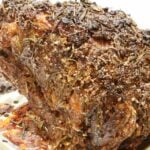
Slow Roasted Prime Rib
This Slow Roasted Prime Rib is marinated and infused with aromatic herbs and spices that are so flavorful, then slow-cooked at low temperature to your desired doneness.
Servings 5
Calories 1610kcal
Ingredients
- 1 5.69 pounds USDA prime rib roast bone-in
- 2 tablespoons olive oil
- 2 ½ - 3 tablespoons kosher salt
- 2 tablespoons peppercorns tri-color or any peppercorns, crushed
- 1 ¼ sprig rosemary remove stem
- ½ teaspoon thyme powder add another ⅛ teaspoon, if you like or use 1 ¼ sprig fresh thyme
- ¼ cup garlic minced
Instructions
- Transfer the frozen prime rib roast to the bottom rack of the refrigerator and thaw for 2 days.
- Make the rub. Combine kosher salt, crushed peppercorns, rosemary leaves, thyme powder, and garlic.
- Brush the prime rib with olive oil, then spread the rub all over the roast. Pat slightly so the rub sticks to the meat.
- Place in a container uncovered and return to the fridge to marinate for ½ a day or overnight.
- Before roasting, remove from the fridge and let it sit on the kitchen counter for 1 to 2 hours to come to room temperature to cook evenly.
- Insert a meat thermometer from the side to the center of the meat, not touching the bones.
- Preheat the oven to 450 degrees F. Place the uncovered prime rib roast on the middle rack and sear for 20 minutes.
- Set the temperature at 300 degrees F after 20 minutes. Cook until the meat thermometer reads 5 to 8 degrees lower than your desired doneness. Note: When removed from the oven and resting, the prime rib roast will continue cooking.
- Don’t follow the time; instead, rely on the meat thermometer temperature. I only provided the time so you have an idea of how long it might take to cook.
- For a rare ribeye roast, cook for 2 to 2 ½ hours with an internal temperature of 120 degrees F.
- For a medium to medium-well ribeye roast, cook for 3 to 4 hours. The internal temperature should reach between 135 - 145 degrees F.
- For a well-done ribeye roast, after 4 hours, cover it with heavy-duty foil. Continue baking for another ½ to 1 hour, depending on how well-done you like it. The internal temperature should reach 160 degrees F.
- Note: Oven temperature varies slightly, so adjust cooking time accordingly.
- Remove from the oven. If the ribeye roast is uncovered, cover and let it sit for 10 to 20 minutes to rest. The roast will continue cooking, so check the meat thermometer until it reaches your desired doneness.
- The crusty rub will fall once you start carving. If the bone is attached with kitchen twine, remove the twine. A typical prime rib serving is ½ inch, but you can slice thicker.
- If bone-in and attached, hold the bone with the prime rib upright. Use a boning knife, start trimming (or slicing) close to the bones and follow the curve until the bones are removed.
- Note: When you buy prime rib, you can request the butcher to trim and reattach the bone onto the roast with kitchen twine, or you can do it yourself.
- For Servings: Slice on the widest area ½ inch or thicker.
Notes
Allow 1 pound per person when buying prime rib roast.
Is Prime Rib the same as Rib Eye Roast? Yes, Prime Rib Roast is the same as Rib Eye Roast, Standing Rib Roast, or Beef Rib Roast. So don’t confuse yourself if it doesn’t specifically say Prime Rib Roast. For example, it might be labeled “USDA Prime BN IN Rib Eye Roast”. “BN IN” means bone-in.
Pay attention though to the label’s description. It should be USDA Prime, not USDA Choice. Prime is a better cut than Choice.
For a few dollars more, get the Prime cut if you have the budget.
Don’t get me wrong, USDA Choice is a good cut of meat and I cook with that too.
Nutrition
Calories: 1610kcal | Carbohydrates: 5g | Protein: 71g | Fat: 143g | Saturated Fat: 58g | Cholesterol: 312mg | Sodium: 7906mg | Potassium: 1221mg | Fiber: 1g | Sugar: 1g | Vitamin A: 22IU | Vitamin C: 2mg | Calcium: 74mg | Iron: 8mg