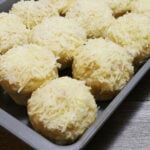
Super Soft Ensaymada Recipe
Ensaymada are soft, fluffy, lightly sweetened Filipino coiled brioche bread rolls topped with butter, sugar, and grated cheese.
Servings 18
Calories 265kcal
Ingredients
Activate Yeast
- 1 packet active dry yeast 2 ¼ teaspoons
- ¼ cup water lukewarm
- 1 teaspoon granulated sugar
Ensaymada Dough Ingredients
- ⅓ cup butter soften (can be replaced with shortening)
- ½ cup granulated sugar
- 1 cup milk room temperature
- 1 teaspoon salt
- 4 egg yolk room temperature
- 4 cups all-purpose flour sifted
Ensaymanda Topping
- ¾ cup butter soften
- ¾ cup powdered sugar
- 1 cup cheese grated
Extra flour for Hands and Kitchen Tools
- 2 – 3 tablespoons all-purpose flour
Instructions
- Activate yeast in ¼ cup lukewarm water and 1 teaspoon sugar. Set aside for 10 minutes.
- In a mixing bowl with whisk attachment, combine soften butter, sugar, ½ cup milk, salt, egg yolk and activated yeast. Whisk at low speed (KitchenAid #2) for 2 minutes.
- Replace whisk attachment with dough hook. Add flour in 3 batches.
- Add 1st batch of flour and beat at low speed (#2) until combined. Scrape the sides of mixing bowl, add the 2nd batch of flour and the remaining ½ cup of milk. Beat until combined at low speed. Scrape again the sides and add the last batch of flour, beat at low speed until combined. Adjust the speed to medium (KitchenAid between #4 to #6 speed) beat until well incorporated. This process will take about 4 to 5 minutes.
- Don’t overwork the dough.
- Dough will be sticky. Once dough starts to clump up on dough hook and pulls away slightly from the sides, flour spatula and hands. Remove dough and form into a ball.
- Transfer dough in a floured (½ teaspoon flour) or greased bowl covered with cloth.
- Rest and rise dough at room temperature for 1 ½ to 2 hours or until it doubled in size.
- Note: I proof dough in oven. Before mixing the dough, I boil water in a medium pot half full and I turn the oven to the lowest setting of 170 degrees F for 4 minutes. When done, place pot in oven with door shut. This will create a warm environment for dough to rise. This is best done when your house has centralized a/c or cold in the house. No need to cover bowl.
- Lightly flour spatula, hands, work area, rolling pin and cutter. Avoid adding too much flour in dough. Remove dough from bowl using spatula. It will deflate on its own without punching the dough.
- Place dough in floured working area. Sprinkle ½ teaspoon flour on top of dough for easy handling. Watch my video (coming soon) to see how I do it.
- Form dough into a log, divide into 3 pieces. Cut each piece into 6 rolls a total of 18 rolls.
- Use a floured rolling pin, take a dough and roll out the piece into 8 inch x 4 inch rectangle. Lightly brush surface with soften butter.
- Roll dough from it widest area into a log, coil and tuck the ends in the middle.
- Place each roll in a greased ensaymada mold. No need to grease non-stick mold.
- Let it rise in room temperature or place mold in oven with oven door shut for 1 hour to rise. Note: Pot of boiling water should be in oven.
- If you are using oven to rise dough, remove mold from oven.
- Preheat oven and bake at 350 degrees F between 12 to 15 minutes or until golden.
- Remove ensaymada from mold as soon as possible and transfer to a wire rack to completely cool.
- Prepare buttercream. Combine soften butter and powdered sugar. Brush top of ensaymada with buttercream and sprinkle grated cheese. Or you can spread soften butter on top of ensaymada, sprinkle some granulated sugar and grated cheese.
- If house is cool, store ensaymada in a sealed container up to 2 to 3 days in room temperature then transfer to fridge. Enjoy!
Notes
This ensaymada recipe yields 18 medium rolls. If you decide to make them smaller, like 24 rolls, adjust the baking time by about 10 to 12 minutes.
Instead of making individual ensaymada, place them in a baking pan, leaving some space between each roll to allow for expansion.
Lastly, if you love cinnamon rolls, you will be happy with this recipe. This dough recipe can be used to make cinnamon rolls. You can make ensaymada and cinnamon rolls at the same time.
Storing: Ensaymada can be stored in the fridge for up to 5 days in a sealed tight container to prevent it from drying out. You can store it in the freezer for up to 2 months. Wrap it tightly in plastic wrap or aluminum foil before placing it in an airtight container or freezer bag to maintain its freshness.
Reheating: When ready to eat, thaw it in the fridge overnight or at room temperature for a few hours. Reheat in the oven at low temperature or in the microwave between 15 seconds to 20 seconds.
Nutrition
Calories: 265kcal | Carbohydrates: 35g | Protein: 6g | Fat: 12g | Saturated Fat: 7g | Cholesterol: 72mg | Sodium: 245mg | Potassium: 134mg | Fiber: 1g | Sugar: 12g | Vitamin A: 666IU | Vitamin C: 3mg | Calcium: 78mg | Iron: 2mg